|
Baseball Short Story
My Proudest Achievement
The Babe Ruth Story: As Told to Bob Considine (1948)
The United States entered the first World War just before the start of the 1917 season, but the draft law was slow in getting into operation and baseball lost comparatively few men in that first war season. ...
However, the country began to become more aware of the war during the winter of 1917-18, and many of the Red Sox went into uniform. Most of them picked the Navy, including manager Jack Barry ... Dick Hoblitzel, our first baseman, started the 1918 season but he went into the Army after a month's play. Like a lot of others, I was deferred as a married man, joined a National Guard unit and kept playing. Barry's enlistment put (owner Harry) Frazee on quite a spot. He had lost Carrigan shortly after buying the club a year before and now he again found it necessary to dig up a new manager. Ed Barrow at the time was president of the International League but Frazee never was a shy guy. Barrow was more than experienced; he had managed the Detroit Tigers and a number of Minor League clubs ... Barrow was a two-fisted, hard-boiled soul who had built up a reputation in baseball as a man who not only knew how to use his fists but liked the idea. He was hot-tempered; and though it was Barrow who helped make me what I became in the game, we had our share of clashes. Barrow was a strict disciplinarian. I was still at the age when I resented anyone pulling the bit too tight on me. As it turned out, we became good friends. We certainly had enough time to mend our differences. Except for 1920, we were together from 1918 until I left the Yankees early in 1935. ... 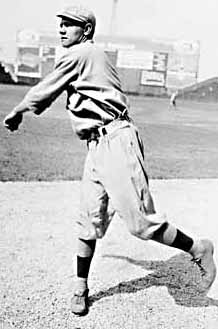 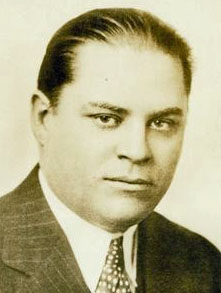 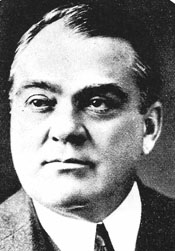 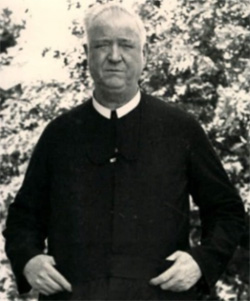 L-R: Babe Ruth, Harry Frazee, Ed Barrow, Brother Matthias We won the pennant again in 1918, the shortest baseball season on record. Secretary of War Newton D. Baker closed down the season on Labor Day in keeping with the country's "work or fight" order. What we were doing naturally came under the head of neither. Frazee was called the "Red Sox wrecker" later on, but some of his war deals made our 1918 pennant possible. We never could have won without the players he obtained from the Athletics: 1B Stuffy McInnis, C Wally Schang, P Joe Bush, and OF Amos Strunk. ... In the general mix-up, they made a part-time outfielder out of a 23-game winner named Ruth. We had a fine defensive club and Barrow got a lot of good pitching out of Carl Mays, Joe Bush, Sam Jones, and myself that year. But we were light at bat, especially against right-handed pitching. ... I had been getting some long hits as a pitcher, despite the soggy ball of 1918. One day that year, Barrow called me to his room. I didn't know what was up, but assumed I had burned him up again. But as I walked in, I found him smiling. "Sit down, Babe. Make yourself at home," he invited. We talked about this and that, while I sweated it out. But finally there was a tense silence. Ed cleared his throat. "Babe," he said, "everybody knows you're a big fellow, healthy and strong. Why can't you take your turn in the box and still play the outfield on days when you're not pitching." I didn't have to think about it very long. "I'll try, Ed, and see how it goes," I said. From then on I was in the line-up every day a right-handed pitcher was against us. I played sometimes at first base, but mostly I was in left field. When a southpaw worked against us Barrow usually tried to maneuver the staff so that I would pitch against him. Occasionally I'd get an afternoon off, but I'd spend it in the bull pen available for pinch-hitting purposes, or I would be called in to relieve. ... I didn't turn from a pitcher to an outfielder overnight, as some people seem to think. It was a gradual sort of thing, and I guess the old German Kaiser deserves an assist in my conversion. Barrow probably would have been committed someplace if he had worked a 23-game winner in the outfield when he still had such players as Duffy Lewis, Chick Shorten and Jimmy Walsh on his team. But 1918 was one of those makeshift seasons. It was like 1944 and 1945 during the last war, when a manager had to make the best of the material he had left on his hands. At that time I would have preferred playing first base during games in which I didn't pitch. But Stuffy McInnis was tops. So I just had to learn how to play the outfield. At first, some of the writers kidded Barrow about playing me in left field. They even made bets I'd be hit on the head by a fly ball before the season's end. But I had been chasing after flies ever since Brother Matthias used to bat them out to us down at St. Mary's with one big hand, and I didn't do so badly. I wasn't any Duffy Lewis out there at the start, but I gradually improved and before the season was over nobody was trying to hit to left or taking any extra bases on me. I loved to throw that ball to any base, from any part of the garden. Between pitching, playing first base and the outfield I appeared in 95 games that season and, odd enoughly cracked out 95 hits. I hit for an even .300. ... In my 95 games I collected 26 doubles, 11 triples and 11 home runs. Today the bat boys hits 11 home runs, but in 1918 it was good enough to get me a tie with "Tillie" Walker of the Athletics as the leading home-run hitter of the American League. |